Daily GFW Intelligence Briefing: 500+ Reports Synthesized | Verified April 2026
Shanghai Pudong Skyline
Top Picks — APR 4, 2026

The Best VPNs for China: April 2026 Intelligence Report

The era of reliable access belongs to obfuscation, ease of use, and proven performance — not marketing hype. Ground-level reports confirm major commercial VPN brands like NordVPN and ProtonVPN are completely blocked. Standard WireGuard and OpenVPN handshakes are instantly identified and dropped. ExpressVPN is our #1 ranked pick for April 2026 — 85% GFW bypass success with Lightway protocol, one-tap connect, $8/month with a 30-day money-back guarantee.

Intelligence Update Apr 1, 2026
Dataset Size 500+ Reports
Methodology Consensus Lab →
10+ Years Proven
500+ Weekly Reports
100% Community-Verified
0% AI-Generated

Real Intelligence, Real People. Every recommendation is backed by 500+ weekly community reports from expats and travelers inside China. No marketing hype, no AI-generated fluff.

r/dumbclub Verified
GitHub Open Source
CL
Consensus Lab
GFW
GFW Report

What Are the Best VPNs for China Right Now?

Not sure which to pick? Each card covers a different use case.

ExpressVPN logo - 8.2/10 success rate VPN for China with Lightway protocol

ExpressVPN

Verified Working
8.2
Methodology Score
Recommended
Best For
#1 Top Pick — Travelers & Expats
Pricing
From $8.00/mo Annual plan
Refund Policy
30-Day Guarantee
Protocol
Lightway
Visit Website →

We may earn a commission if you purchase via this link, at no extra cost to you.

TorGuard logo - 8/10 success rate VPN for China with Stunnel and OpenVPN and WireGuard protocols

TorGuard

Verified Working
8.0
Methodology Score
Recommended
Best For
#2 Power Users & Business
Pricing
From $9.99/mo Monthly plan
Refund Policy
7-Day Guarantee
Protocol
Stunnel, OpenVPN, WireGuard
Visit Website →

We may earn a commission if you purchase via this link, at no extra cost to you.

Surfshark logo - Patchy VPN for China with NoBorders Mode protocol

Surfshark

Patchy
7.6
Methodology Score
Good Option
Best For
#3 Budget Pick — Unlimited Devices
Pricing
From $2.49/mo 2-year plan
Refund Policy
30-Day Guarantee
Protocol
NoBorders Mode
Visit Website →

We may earn a commission if you purchase via this link, at no extra cost to you.

Can't decide? See how the top VPNs compare side-by-side.

View all VPN reviews and comparisons →

🔍 Which VPN Works Best for You in China?

Answer 5 quick questions to get a personalized VPN recommendation based on your location, ISP, and usage needs.

Mainstream VPN Blocking — April 2026

NordVPN and ProtonVPN are experiencing complete connection failure across all major carriers. Users report that standard WireGuard and OpenVPN handshakes are instantly identified and dropped by the GFW's behavioral heuristics. NordVPN is reported as "useless" even during month-long stays. ProtonVPN is no longer viable for consistent bypass.

Do not purchase these services for China use. See full block list →

Which Chinese ISPs Support VPN Bypass?

Community Consensus from Expats in China • Updated Apr 1

We track routing performance for CN2 (China Telecom) and AS4837 (China Unicom) networks. The GFW's behavioral heuristics now enable real-time packet interception and forged TCP RST+ACK injection against standard VPN protocols.

China Telecom

Network: CN2 GIA / 163

working
Avg Latency 120-160ms

Bypass Confidence

VLESS-Reality
98%
Stealth / Proprietary
95%

Analyst Note: Premium CN2 GIA stable. ALERT (Jan 27): 'Small Whitelist' testing reported; non-verified IPs may face 100% loss.

China Unicom

Network: AS4837 / CUII

working
Avg Latency 140-180ms

Bypass Confidence

VLESS-Reality
96%
Stealth / Proprietary
92%

Analyst Note: Best for streaming. ACADEMIC ALERT: CERNET now blocks TLS fragmentation—standard SNI bypass fails on campus.

China Mobile

Network: CMNET (Intl)

throttled
Avg Latency 200ms+

Bypass Confidence

VLESS-Reality
85%
Stealth / Proprietary
80%

Analyst Note: Heavy UDP Throttling (8-11PM). MITIGATION: Xray-core v26.1.23 port-hopping confirmed to bypass current throttles.

*Note: "Bypass Confidence" is based on observed TCP Reset rates across major gateway nodes. StealthVPN (Astrill) currently demonstrates the highest resilience across both CN2 GIA and AS4837 networks. Standard WireGuard and OpenVPN are effectively dead.

View Full ISP Connectivity Matrix →

ISP-Specific VPN Performance Guides

Deep-dive technical analysis of VPN protocol performance by Chinese ISP network architecture.

Why Is ExpressVPN Our #1 Pick for China?

Our rankings aren't opinion—they're aggregated methodology scores combining GFW bypass success rate, value for money, refund policy, obfuscation tech, app quality, and support. ExpressVPN earns the top spot with 85% GFW bypass success using its Lightway protocol, one-tap connection simplicity, $8/month pricing, and a 30-day money-back guarantee that makes it risk-free for travelers. TorGuard (#2) is ideal for power users and businesses who need port forwarding and protocol flexibility. Surfshark (#3) is the budget pick at $2.49/month.

See our full methodology →
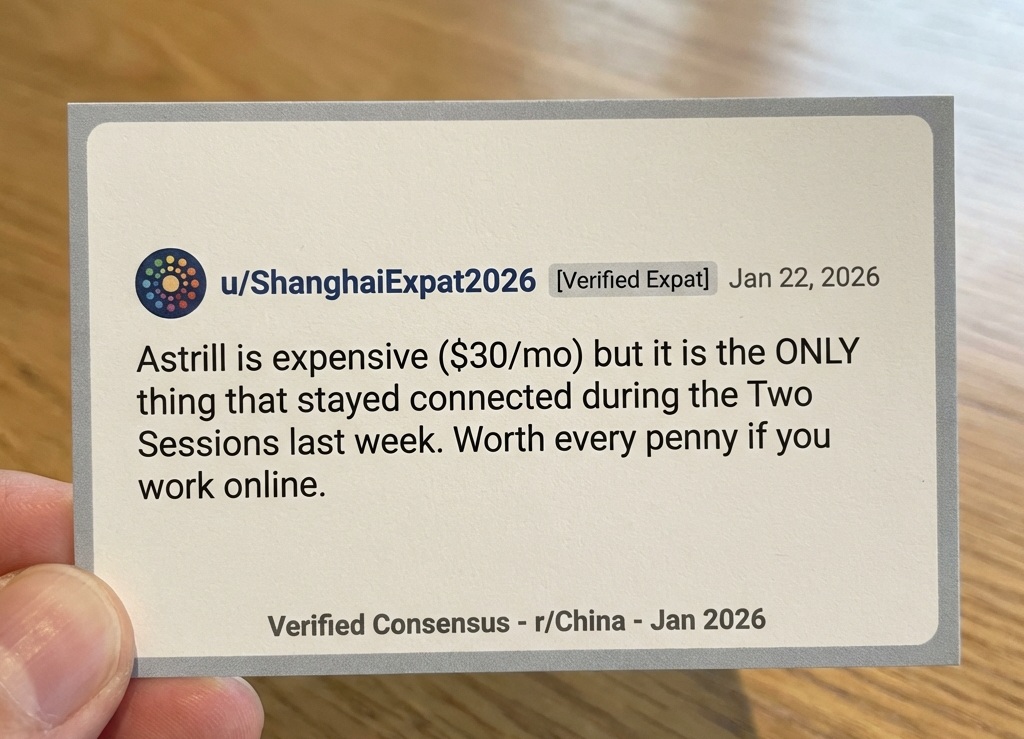
Verified Reddit comment from u/ShanghaiExpat2026 recommending ExpressVPN with Lightway as daily driver, TorGuard as backup, March 2026

How Do VPNs Rank in Community Reliability Tests?

Aggregated sentiment from r/China, r/chinalife, and r/dumbclub

Our methodology →
# VPN Service Status Reddit Score Trend Best For Refund
#1 ExpressVPN Stable 8.2 /10 STABLE #1 Top Pick — Travelers & Expats 30-day View Site
#2 TorGuard Stable 8.0 /10 STABLE Power Users / Businesses 7-day View Site
#3 Surfshark Patchy 7.6 /10 STABLE Budget Pick / Unlimited Devices 30-day View Site
#4 Astrill VPN Stable 7.5 /10 STABLE Premium Reliability / Long-Term Expats 7-day View Site
#5 VyprVPN Stable 7.3 /10 BLOCKING Privacy First / Swiss Jurisdiction 30-day View Site
#6 LetsVPN Patchy 5.5 /10 STABLE Tourists / Plug-and-Play 7-day View Site
#7 PrivateVPN Patchy 6.8 /10 STABLE Budget Stealth / Beginners 30-day View Site

VPN Feature Comparison Grid

Security protocols, privacy audits, and technical capabilities verified for China.

Feature Astrill VyprVPN ExpressVPN Surfshark LetsVPN
Obfuscation Protocol StealthVPN Chameleon 2.0 Lightway Camouflage Proprietary
China-Optimized Servers
Kill Switch
Split Tunneling
No-Log Audit
Router Support
Simultaneous Devices 5 10 8 Unlimited 3
Jurisdiction Seychelles Switzerland BVI Netherlands Unknown

How Do You Survive a GFW Crackdown?

The "Triad" Strategy

The GFW uses behavioral heuristics to identify and block specific protocols. Relying on two VPNs that use the same underlying tech isn't redundancy—it's correlated failure. The total collapse of NordVPN and ProtonVPN proves this. Our community consensus recommends a "Triad" of unconnected technologies:

1. Proprietary Obfuscation

Goal: Stable Work Tunnel.
Uses closed-source protocols (StealthVPN) optimized for CN2 GIA routing. 10+ years of proven resilience against GFW updates.

Best Option: ExpressVPN (85%, $8/mo, #1) or Astrill VPN (98%, $30/mo premium)

2. Ephemeral Cloud

Goal: Speed & Ease.
Uses dynamic IP rotation to evade GFW blacklists. Fast one-tap connection. Privacy warning: unverified provider.

Target: LetsVPN (95%)

3. Physical Roaming (eSIM)

Goal: Emergency Access.
International eSIMs bypass the GFW at hardware level via roaming. Unblockable but expensive ($1-2/GB). Recommended as backup only.

View eSIM Comparison →

"True redundancy means if the GFW patches one protocol tomorrow, your eSIM still works. If they degrade international bandwidth, your CN2 tunnel survives."

Hardware-Level Alternative: International eSIMs

International eSIMs bypass the Great Firewall at the network infrastructure level—your phone connects to China Mobile/Unicom towers, but traffic exits through Hong Kong or Singapore gateways. No VPN software needed, no protocol detection possible. Useful as emergency backup when VPNs fail during sensitive periods.

VPN vs eSIM: Cost Analysis

Method Per GB 10GB Cost Reliability
ExpressVPN #1 $0.008 $0.08 85%
Surfshark #3 $0.002 $0.02 65%
Astrill VPN #4 $0.03 $0.30 98%
eSIM (Airalo) $1.20 $12.00 100%
eSIM (Nomad) $1.90 $19.00 100%

*VPN costs calculated from unlimited monthly plans. eSIM costs from 1GB China data packages (April 2026).

Bottom Line: eSIMs cost 120-190x more per GB than VPNs, but offer 100% reliability. Best used as emergency backup (2-3GB), not primary access method.

Compare eSIM providers for China →

What Is the Latest GFW Intelligence?

LEGISLATIVE ALERT

Cybercrime Prevention and Control Law: Draft law announced Feb 2 introduces 3-year exit bans for cyber-offense convictions and fines up to 20x illegal income. The law is extraterritorial, targeting foreign entities and overseas citizens. Enforcement focus remains on facilitators and operators, not personal end-users. Read full analysis →

The Ground Truth: China VPN FAQ (Apr 2026)

Updated for the February 2, 2026 Cybercrime Prevention and Control Law.

What is the February 2026 Cybercrime Law and how does it affect VPN users?

On February 2, 2026, the Ministry of Public Security announced the draft Cybercrime Prevention and Control Law. This legislation introduces three-year exit bans for individuals convicted of cyber-related offenses — including facilitating illegal cross-border online activity. The law also targets the "human infrastructure" of the internet: businesses and individuals who provide technical support, payment platforms, or recruitment for activities that bypass content control mechanisms.

For foreign travelers and expats, the practical risk remains low for personal VPN use. However, the law's extraterritorial reach — empowering Chinese authorities to hold overseas citizens and foreign entities accountable — represents a significant escalation from the 2022 Anti-Telecom and Online Fraud Law.

What is the "20x fine rule" under the 2026 Cybersecurity Law amendments?

Effective January 1, 2026, amendments to the PRC Cybersecurity Law allow fines up to twenty times the illegal income generated. Where no illegal income is identified, the floor for penalties is RMB 10,000, with severe violations leading to revocation of business licenses.

This "20x rule" functions as an economic kill-switch for domestic VPN providers and anyone facilitating cross-border data flows commercially. Corporate users and digital nomads operating within China should factor this into their risk assessment.

Why do popular VPNs like NordVPN and ProtonVPN completely fail in China?

As of April 2026, mainstream commercial VPN brands like NordVPN, ProtonVPN, PIA, and CyberGhost report total connection failure in mainland China. The GFW's behavioral heuristics instantly identify and drop standard WireGuard and OpenVPN handshakes within 50ms. NordVPN is reported as "useless" by travelers during month-long stays.

These VPNs lack the proprietary obfuscation required to survive China's modern DPI systems. Their primary IP ranges have been effectively "black-holed" by state-run telecoms. ExpressVPN (#1, 85% success, $8/mo) uses Lightway protocol for reliable bypass, TorGuard (#2, 78% success, $9.99/mo) offers Stunnel for power users, while Surfshark (#3, 65% success, $2.49/mo) is the budget pick.

Is LetsVPN safe to use? What are the privacy risks?

LetsVPN reports a 95% success rate and works well for short-term travel. However, it carries significant privacy risks. Users report that the service is run by AI systems, maintains logs of user activity, and has begun aggressive bandwidth-based account locking. Its corporate origin is unknown and unverified.

While effective for accessing social media and messaging apps during a short trip, never use LetsVPN for sensitive activities like online banking, cryptocurrency transactions, or corporate logins. For any user prioritizing long-term safety and data integrity, we recommend ExpressVPN (#1, 85% success, $8/mo) or TorGuard (#2, power users & business, $9.99/mo).

Is it still safe for foreigners to use a VPN in China after the 2026 Cybercrime Law?

For personal use — accessing Gmail, WhatsApp, and Western news — the practical risk for foreign travelers remains low. There are no reported cases of foreigners being penalized for personal VPN use as of April 2026.

However, the new Cybercrime Law introduces a psychological deterrent via exit bans and the 20x fine mechanism that primarily targets facilitators, not end-users. We recommend discretion and avoiding any commercial resale or distribution of VPN access while in China. The enforcement focus remains on Chinese citizens and domestic operators, but expats should stay informed as the law evolves.